 This post is for my sewing friends:
 I finally took time to go down to Ephrata, Washington to take the training on my Innova quilting machine. I purchased it last November and the closest dealer was Cindi Rang who has a great little quilting shop: http://www.fabricpatch.net/
So ... I'm posting some photos of the sample we worked on.
Cute little flowers. I worked freehand, which is the type of quilting I do. We did some border treatments,
I worked freehand, which is the type of quilting I do. We did some border treatments, and alphabets.
some abstracts ... a sun ...
 scribbles ...
  Raw edge applique ...
  and a design outlined from a stencil.
 We added a few trees.
a sun ... scribbles ... Raw edge applique ... and a design outlined from a stencil.
 We added a few trees.
 Remember, I didn't promise perfection!
This is one great machine and I wish I had more time to work on it! Hopefully, I will get some time in the next few months.
This is Cindi and me with my quilt 'Pink Snow', my first quilt on my Innova.  It was made last spring for the Vancouver Cherry Festival and was recently on display at the La Conner Textile Museum's Quiltfest.
It was made last spring for the Vancouver Cherry Festival and was recently on display at the La Conner Textile Museum's Quiltfest.Detail:
I found a fabric with a delicate print of willows and abstract designs. I followed the design to create the background. The flowers were made from a 're-used' silk blouse and appliqued on.The title came from the pink snow blossoms that flutter down in my driveway with the May breeze.


 The animals that roamed before the ice ages were very different.
 This is one little bit of animal life surviving today ...
  Some lakes support wild birds and fishermen.
  Wild baby's breath flourishes where there is a little moisture.
  Otherwise, tough grasses and bushes live on the dry hills.
 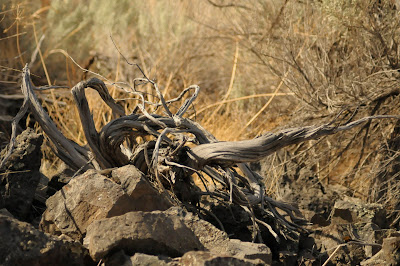 Bushes like this can be hundreds of years old.
 This model depicts a rhinoceros that lived during the Miocene period and was engulfed by a lava flow. As the lava hit the lake, it cooled and left a unique mold of it's body that is visible near Blue Lake at Sun Lakes state Park. A few bones of the large animal were also in the area. It was a young animal and was probably dead and bloated. The size would be 8 feet from snout to tail. This took place in the time between one and 25 million years ago.
 The funny part of all this is that no one believed my story of the
  We were told that a 'must see' is the Dry Falls. An unpaved road led down into a basin. Towering above us was the Dry Falls.When we looked up we saw a building on the other side.
 The building was the observatory overlooking the Dry Falls. Later we drove up to the observatory and the photo below is what we saw from that viewpoint.
 This is a drawing of the falls in the time of the ice ages.
 Standing below, the rock forms showed the heavy erosion of thousands of years ago.

 The cliffs show the layers of rock formed over millions of years by lava flows.
 Then, during the ice ages the layers were dug away by the massive flooding.
 Basalt cliffs had huge pillars of rock.
 If you look up, the cliffs hide caves caused by drainage and the powerful action of the falls.
 From here, we drove to the Grand Coulee Dam, built in the 1960's. Its water supplies power and irrigation for the farmlands up on the plateau. Dinner was less than memorable. It was the first time I had chopped lettuce with
  On the way back to
  We stopped at the observatory on the way back and the moon was reflecting in the lake at the base of the dry falls.
 The deep gorge had viewing spots where the native
 We crossed a bridge to farmland made lush from irrigation. On the other side, we visited the petrified forest (photos below).
 Highway 90 was 4 lanes and we made good time.

